Best practices after positive Spinal Muscular Atrophy newborn screening
- Number 292
- Date 23 January 2026
292nd ENMC International Workshop:
Location: Hoofddorp, The Netherlands
Title: Best practices after positive Spinal Muscular Atrophy newborn screening
Date: 23-25 January 2026
Organisers: Prof. Liesbeth De Waele (Belgium), Prof. Eduardo Tizzano (Spain), Prof. Monika Gos (Poland), Marie-Christine Ouillade (SMA Europe)
Early Career Researcher: Dr Laura Carrera-Garcia
Report: Dr Tamara Dangouloff
Translations of this report by:
Czech by Prof. Jana Haberlova
Dutch by Dr Renske Wadman
French by Marie-Christine Ouillade
German by Prof. Jan Kirschner
Italian by Prof. Marika Pane
Polish by Dr Jakub Tomczyk
Russian by Mrs. Olga Germanenko
Serbian by Dr Miloš Brkušanin
Spanish by Dr Laura Carrera-Garcia
Sweden by Prof. Thomas Sejersen
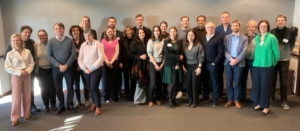
Participants: Giovanni Baranello (UK), Bart Bartels (Netherlands), Miloš Brkušanin (Serbia), Laura Carrera-Garcia (Spain), Tamara Dangouloff (Belgium), Basil Darras (USA), Michelle Farrar (Australia), Olga Germanenko (Russia), Monika Gos (Poland), Jana Haberlova (Czech Republic), Jan Kirschner (Germany), Katarzyna Kotulska-Jozwiak (Poland), Vincent Laugel (France), Henny Lemmink (Netherlands), Wolfgang Mueller-Felber (Germany), Andres Nascimento (Spain), Magali Ngawa (Belgium), Maryam Oskoui (Canada), Marie-Christine Ouillade (France), Marika Pane (Italy), Susana Quijano-Roy (France), Thomas Sejersen (Sweden), Eduardo Tizzano (Spain), Jakub Tomczyk (Poland), Renske Wadman (Netherlands), Liesbeth De Waele (Belgium)
Summary
The 292nd ENMC workshop was held from 23–25 January 2026 in Hoofddorp, The Netherlands, and brought together neuromuscular experts and patient representatives from Europe, North America, and Australia to discuss best practices following a positive newborn screening (NBS) result for spinal muscular atrophy (SMA). The meeting addressed key post-screening steps, including confirmation of the diagnosis, communication with families, treatment decision‑making, timelines to treatment, and long‑term follow‑up.
SMA is a rare neuromuscular disease caused by the absence of the SMN1 gene, leading to progressive motor neuron degeneration. Therefore, weakness of voluntary muscles mainly dominates the manifestations with a variable degree of involvement, ranging from very severe congenital cases to weakness that may appear in adult life. While SMN1, the determinant gene, is missing, SMN2 acts as a backup gene, producing small amounts of functional SMN protein. Thus, the number of SMN2 gene copies influences, without fully predicting, disease severity. The more SMN2 copies, the less severe the manifestations. The availability of disease‑modifying therapies and evidence showing that treatment is most effective when started early have motivated the rapid expansion of NBS programmes worldwide. However, early identification also introduces challenges: variability in SMN2 copy number assessment, uncertainty in prognosis (particularly for infants with ≥4 SMN2 copies), the emotional burden on families receiving an unexpected diagnosis, and the shared decision-making in therapy choice with management of expectations.
The workshop aimed to harmonise approaches for confirming the genetic diagnosis, particularly regarding the determination and quality assessment of SMN2 copy number. Another key objective was to define shared principles to guide treatment decisions for both symptomatic and presymptomatic infants detected by NBS, including those with ≥4 SMN2 copies. Participants also sought to identify practical ways to reduce delays between a positive screening result, diagnostic confirmation, and the start of treatment. Communication with families, long-term follow-up priorities, and international data collaboration were key discussion points.
Participants agreed on key laboratory and clinical principles to be integrated into updated best-practice guidelines. These include the need for accurate and repeatable SMN2 copy number testing, harmonised reporting, and re-testing strategies when results are uncertain. For clinical management, participants emphasised that symptomatic infants require immediate treatment without delay by confirmatory testing, and that prolonged “watch‑and‑wait” approaches for infants with 4 SMN2 copies are associated with poorer outcomes and should be avoided.
The workshop highlighted the importance of standardised pathways to shorten time to treatment, clear communication skills and tools for families, and support measures aligned with each centre’s resources. Proposed deliverables include updated laboratory guidelines, communication recommendations, and development of a minimal international dataset for long-term follow-up and federated data sharing. The role of multidisciplinary teams in consistent follow-up was underlined. Participants also noted the expanding role of biomarkers, such as neurofilament levels and digital biomarkers, which may support earlier identification of disease activity and help refine prognosis and treatment response. These outputs will feed into the ENMC workshop report, together with collaborative initiatives aimed at improving real-world data collection.
By promoting earlier and more accurate diagnosis, clearer communication, and timely treatment initiation, the workshop’s recommendations aim to reduce disease progression, improve developmental outcomes, and lessen the emotional burden on families. Harmonised standards can also reduce inequalities in access to optimal care across countries.
Next steps include drafting the full workshop report, updating the international NBS white paper (under the umbrella of the European Alliance for Neonatal Screening), defining an international minimal dataset, advancing registry harmonisation efforts, and developing communication guidelines for families.
A full report will be published in Neuromuscular Disorders.