Collagen VI fundamental insights and preclinical innovations: advancing towards translation for COL6-RD
- Number 296
- Date 19 June 2026
296th ENMC International Workshop
Location: Hoofddorp, The Netherlands
Title: Collagen VI Fundamental Insights and Preclinical Innovations: Advancing Towards Translation for COL6-RD
Date: 19–21 June 2026
Organisers: Dr. V. Allamand (France), Prof. C. G. Bönnemann (USA), Dr. C. Jiménez-Mallebrera (Spain)
Early career researchers: D. Kourtzas (France), M. Frías Nestares (Spain), N. Osegui-Barcenilla (Spain)
Translations of this report by:
German: Dr. U. Kleinholdermann
French: Dr. V. Allamand
Greek: Mr. D. Kourtzas
Czech: Mr. D. Kourtzas
Italian: Dr. A. Ambrosini
Spanish: Mr. M. Frías Nestares
Japanese: Dr. S. Noguchi
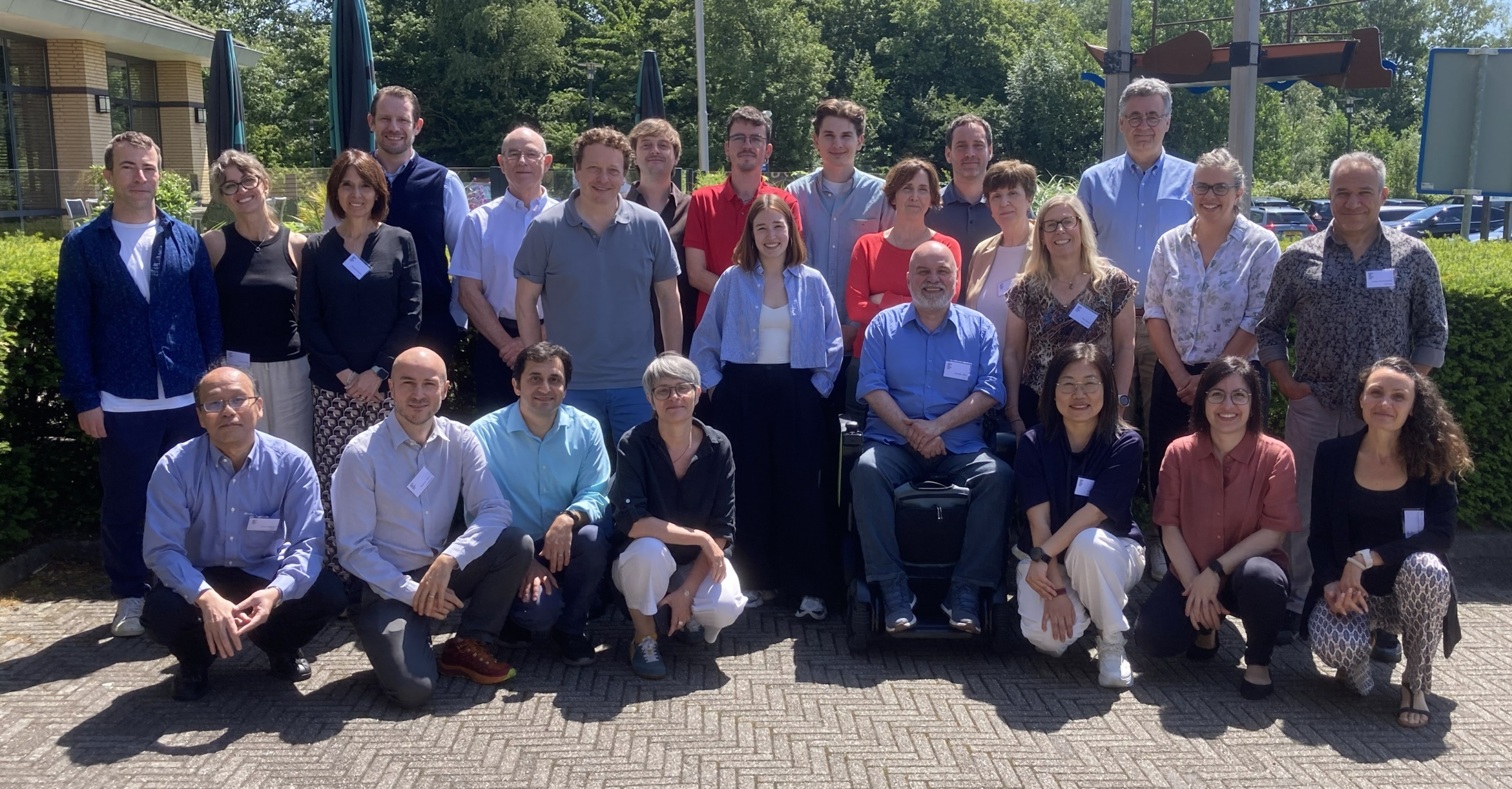
Participants: Dr. V. Allamand (France), Dr. C. Jimenez-Mallebrera (Spain), Prof. C. Bönnemann (USA), Dr. V. Cenni (Italy), Dr. P. Mohassel (USA), Dr. A. Schiavinato (Germany), Dr. S. Noguchi (Japan), Prof. C. Baldock (UK), Dr. M. Tiburcy (Germany),Prof. S. Tedesco (UK), Dr. V. Arechavala-Gomeza (Spain), Prof. H. Zhou (UK), Dr. V. Bolduc (USA), Dr. A. Brull (USA), Dr. A. López-Marquez (Spain), Prof. F. Muntoni (UK), Dr. A. Recchia (Italy), Dr. N. Dumont (Canada), Mr. D. Kourtzas (France), Mr. M. Frías (Spain), Ms. N. Osegui (Spain), Dr. G. Dziewczapolski (patient representative, USA), Dr. U. Kleinholdermann (patient representative, Germany), Dr. A. Mejat (France), Dr. A. Ambrosini (Italy), Prof. R. Quinlivan (UK).
Background information
Collagen VI-related dystrophies (COL6-RD), which include Ullrich congenital muscular dystrophy, intermediate forms, and Bethlem muscular dystrophy, are rare congenital genetic muscle and connective tissue conditions. They are caused by mutations in the genes that make Collagen VI (COL6A1, COL6A2, and COL6A3). Collagen VI is a protein found in the extracellular matrix, the supportive structure that surrounds our cells, providing a scaffold to hold structures like muscle cells and tendons together. When this scaffolding is faulty, it can cause progressive muscle weakness, contractures, scoliosis, breathing problems, and fatigue. Currently, medical care focuses on managing these symptoms and preventing complications. Because the condition is complex and progresses over time, a major challenge remains in understanding how matrix defects lead to muscle cell damage and scarring.
Workshop aims
The workshop brought together international researchers, clinicians, and patient representatives to figure out how recent laboratory discoveries can be turned into meaningful outcomes for patients. The main goals were to review what is known about Collagen VI biology, identify remaining knowledge gaps, compare different laboratory models, like cells and mice, and build a coordinated plan to link laboratory tests to real-world clinical outcomes that matter most to patients.
Workshop outcomes/deliverables
The experts made several key steps forward:
- Understanding the disease: Participants mapped out how a broken supportive cell framework triggers scarring pathways, like the TGF-beta pathway, and affects surrounding support systems like muscle stem cells and tendons.
- Advanced lab & animal models: Researchers demonstrated major progress using lab-grown 3D "mini-muscles" (organoids) and mouse models to safely test physical strength and use automated imaging to study how the scaffolding structure forms.
- New technologies: The group explored advanced genetic correction therapies, such as gene editing and other precise genetic tools, as well as different vectors that could be used to deliver these therapies and correct mutations directly. They also discussed how modern computer programs and Artificial Intelligence (AI) can be explored to help doctors achieve faster and more accurate rare disease diagnoses.
Impact on the patients and their families
While the workshop does not mean an immediate cure is available today, it marks a huge, coordinated leap forward toward clinical trial readiness. By improving precise gene-correcting tools, optimizing diagnostic timelines, and organizing patient data through international registries like the Congenital Muscle Disease International Registry (CMDIR), the scientific community is laying the groundwork to design future trials much more efficiently. This collaborative approach ensures future studies will focus on outcomes that directly improve daily life, such as preserving mobility, joint flexibility, and breathing quality.
Next steps
During the open discussion sessions, the consortium agreed on several immediate actions:
- Material Sharing: Laboratories will work toward building a global network to share research materials, including control and patient cell lines, and induced pluripotent stem cells (iPSCs) as they become available. The group also discussed the importance of sharing protocols and therapy tools, such as ASOs, siRNA sequences, and vectors, when possible. This would help researchers test possible treatments in a more consistent and reliable way and make sure results can be repeated across different laboratories and countries.
- Unresolved Science: Researchers will study the exact lifespan of normal and mutated collagen VI directly in tissues to help design accurate treatment regimen.
- Delivery Optimization: Future work will focus on improving safer delivery vehicles to make sure potential gene therapies effectively reach primarily the cells that produce COLVI, like the fibro-adipogenic progenitors (FAPs), and also hard-to-target muscles, like the diaphragm.
- Combining data: The group will gather more long-term health information for the CMDIR database. This will help us put patients into the right groups for future medical studies.
A full report will be published in Neuromuscular Disorders (PDF).