Optimizing collaborative models in Neuromuscular Diseases: the role of ontologies and Artificial Intelligence
- Number 291
- Date 16 January 2026
291st ENMC International Workshop
Location: Hoofddorp, The Netherlands
Title: Optimizing Collaborative Models in Neuromuscular Diseases: The Role of Ontologies and Artificial Intelligence
Date: 16-18 January 2026
Organisers: Prof. Cynthia Gagnon (Université de Sherbrooke) and Prof. Anita Burgun (Université Paris Cité)
Early Career researcher: Ms Marie-Pier Dominque (Canada)
Translations of this report by:
French by Ms Marie-Pier Dominque
Swedish by Santa Slokenberga
Polish by Prof. Joanna Polanska
Italian by Prof. Rossella Tupler
Dutch by Prof. Peter-Bram ‘t Hoen
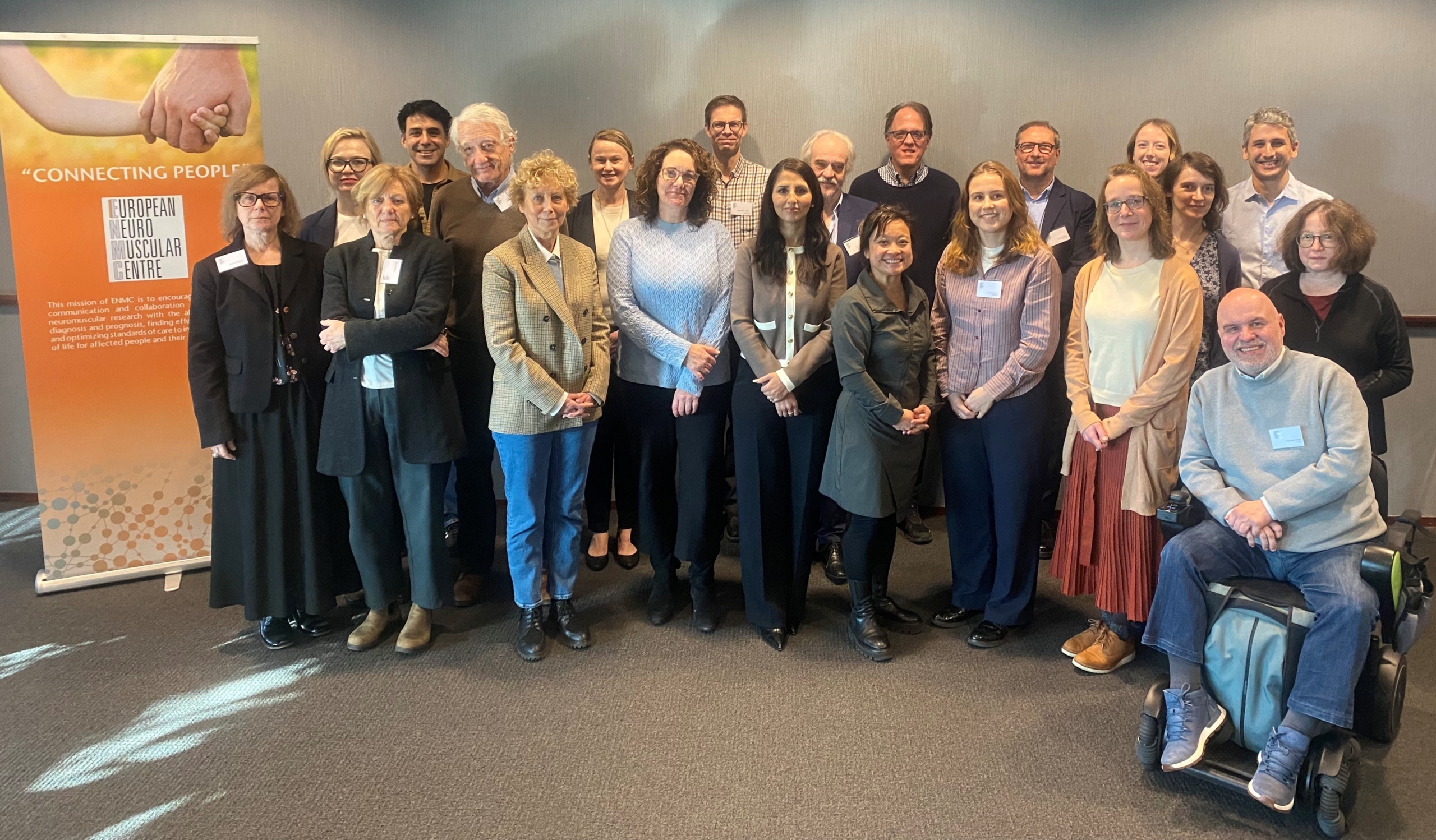
Participants: Prof. Cynthia Gagnon (Canada), Dr Rachel Thompson (Canada), Prof. Anita Burgun (France), Dr Daniel Natera-de Benito (Spain), Dr Tina Duong (United States), Prof. Peter-Bram ‘t Hoen (Netherlands), Dr Nicole Voet (Netherlands), Prof. Nicholas Johson (United States), Dr Peter Robinson (Germany), Prof. Paul Schofield (UK), Prof. Roman Hossein Khonsari (France), Prof. Christina Khnaisser (Canada), Dr Homira Osman (Canada), Dr Alain Geille (France), Dr Ignacio Escuder Bueno (Spain), Ms Marie-Pier Domingue (Canada), Dr Alexandre Méjat (France), Dr Allison Kreuzer (United States), Dr Carole Faviez (France), Prof. Joanna Polanska (Poland), Prof. Rossella Tupler (Italy), Dr Lilli Schuckert (Netherlands), Dr Johan van Beek (United States), Dr Santa Slokenberga (Sweden)
Summary:
The 291st ENMC Workshop took place from January 16 to 18, 2026. During the meeting, international experts from different fields including patient representatives discussed the difficulties of managing data in rare neuromuscular diseases. A major challenge is that data are often collected in different ways by different teams, which makes it hard to combine or compare results. Improving data harmonization—meaning describing and recording data in the same way across studies—was identified as a key priority to facilitate collaboration.
To support this, some projects use shared “dictionaries” or classification systems. For example, the Human Phenotype Ontology (HPO) is used to describe symptoms in a standardized way, and the International Classification of Functioning, Disability and Health (ICF) is used to describe how a disease affects daily functioning. These dictionaries are also combined with artificial intelligence methods to better analyze data. In different European and International projects, classification systems specific to neuromuscular diseases are being developed based on HPO and ICF, with input from experts from different disciplines. However, the group noted that there is still a lack of harmonization of collected outcome measures across studies, and this remains an important unmet need.
Research progress depends on being able to use and connect many types of data, such as medical images and clinical information. However, sharing data can be difficult because of privacy and legal constraints. One promising solution discussed was federated learning. This approach allows researchers to analyze data stored in different places without moving or directly sharing sensitive patient data, which helps protect privacy of personal health data. To facilitate the use of all types of data, an approach discussed was the use of artificial intelligence tools to extract useful information from unstructured data including medical images and clinical reports.
New regulations, such as the ones associated with the European Health Data Space, are expected to influence how health data can be shared. These rules may bring both new opportunities and new challenges for rare disease research. The role of consent in data sharing requires ongoing dialogue to ensure everyone understands how their data is used, who has access to it, and which security measures are in place to protect privacy. Importantly, patients with rare diseases expressed a strong willingness to share their data to support research and clinical care, as long as there is reciprocity. Patients want their data to be used ethically and responsibly, and to receive feedback or results when possible. In regard to ownership, further discussions are needed to reconcile the different interests about control over the data, and the group suggested exploring models of shared access of data between patients, clinicians, and researchers. This is particularly important as more data types relevant in the field of muscular diseases (2D and 3D clinical photography, clinical movement capture, voice capture) will be increasingly collected in numerous locations in the coming years.
The workshop ended with agreement on the need for a shared, collaborative structure and a clear roadmap to move these priorities forward. The main goal is to improve research efficiency, increase patients’ participation, foster multidisciplinary collaboration, and ensure that data sharing directly benefits people living with rare neuromuscular diseases.
A full report will be published in Neuromuscular Disorders.